
Finding skilled IT talent has never been more competitive. Companies are scrambling to fill roles in cybersecurity, cloud computing, software development, and data engineering — often fighting over the same small pool of candidates. Traditional job boards simply cannot keep pace with how fast this sector moves. That is exactly why forward-thinking hiring teams are turning to a dedicated hire IT resume database to cut search time, reduce cost-per-hire, and connect with pre-vetted professionals who are genuinely ready to make a career move.
Key Takeaways
- A hire IT resume database gives recruiters direct access to thousands of pre-screened technology professionals, dramatically reducing time-to-fill for specialized roles.
- Using a hire IT people resume database allows filtering by skills, certifications, experience level, and availability — so you only spend time on qualified matches.
- Unlike passive job boards, an IT hire resume platform often includes candidates who are not actively applying but are open to the right opportunity.
- Structured resume hire IT searches help align talent acquisition with budget cycles, project timelines, and headcount planning.
- Companies that adopt a dedicated hire IT people resume strategy consistently report higher offer acceptance rates and lower first-year turnover.
The Real Cost of Hiring IT Talent the Old Way
Most HR teams already know the pain. You post a senior DevOps engineer role on a general job board, get 200 applications, and discover that maybe 12 of them actually understand Kubernetes beyond surface-level buzzwords. The rest of the stack? Noise.
Many times, in US staffing recruiters said the major problem and issues they are basically facing is to get the local candidate for the particular skill set also particular visa status is also matters, so here hire it people resume database provide every recruiter a flexibility to filter resume with visa status and location for faster and smarter submission.
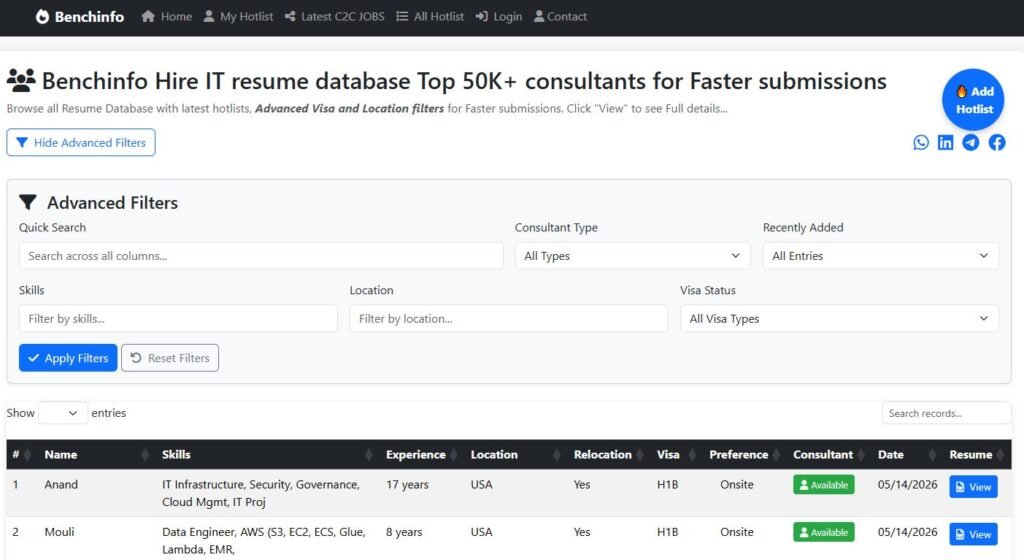
The average time-to-hire for IT roles sits between 40 and 60 days depending on seniority and specialization. At that pace, a critical product launch waits, client deliverables slip, and existing team members burn out covering the gap. The math quickly gets ugly when you factor in recruiter hours, agency fees, and lost productivity.
A purpose-built hire it resume database changes that math entirely. Instead of broadcasting to the general public and hoping the right person sees it, you go directly to a curated pool for C2C requirements where every profile belongs to someone with verified technical experience. You search, you shortlist, you reach out — all within the same platform and often within the same afternoon.
What Makes an IT-Specific Resume Database Different
Not all resume databases are built the same way. General talent platforms cast a wide net across every industry, which means the signal-to-noise ratio for technical searches is often poor. An IT-focused database is structured around the specific language of the technology sector.
When you search for a hire it people resume, the platform understands the difference between a front-end developer who dabbles in React and one who has shipped production applications with TypeScript, Next.js, and accessibility standards baked in. Taxonomy matters enormously here. Proper categorization of programming languages, frameworks, cloud platforms, security certifications, and agile methodologies is what separates a genuinely useful database from a glorified spreadsheet.
Here is what a strong hire it resume database typically offers that general platforms do not:
Granular Skill Tagging — Candidates tag their profiles with specific technologies, not just job titles. A search for “AWS Solutions Architect with Terraform experience” returns profiles that actually match, rather than anyone who once put “cloud” on their resume.
Certification Verification — Many platforms now cross-check credentials like CompTIA Security+, AWS Certified Professional, Certified Kubernetes Administrator, and others against issuing bodies. This removes one layer of manual verification from your process.
Availability Signals — Rather than guessing whether someone is passively browsing or actively job hunting, modern hire it people resume database platforms let candidates set availability windows. You know before you send that first message whether someone is “open to opportunities immediately” or “exploring options for Q3.”
Project-Based Profiles — IT professionals often tell their story through what they have built. A good database surfaces GitHub links, deployed projects, technical write-ups, and case studies alongside the traditional resume. This gives you a richer view of how someone actually works, not just where they worked.
Daily Updated Hire it resumes database download for Quick Submissions
| Candidate | Technology | Visa | Experience | Location | Relocation | Resume |
|---|---|---|---|---|---|---|
| Venu | Sr. Java Developer | H1b | 9 | San Jose, CA | Open | view resume |
| Shushanth | Java full stack Developer | H1B | 8 | Tampa, FL | Open | view resume |
| Rajendrakumar | Business Analyst/Project Manager | H1B | 8 | Dallas, TX | Open | view resume |
| Sagar | GRC Cyber security | H1B | 10 | Atlanta, GA | Open | view resume |
| Nathasha | Business Analyst | H1B | 8 | Atlanta GA | Remote | view resume |
| Kevin | Business Analyst/ GEN AI | H1B | 10 | Nashua, NH | Open | view resume |
| Rabitul | QA Lead Tester | USC | 11 | Long Tree, CO | Open | view resume |
| Harshitha | Network Engineer | H1B | 8 | Cleveland, OH | Open | view resume |
| Meraj Unisa | Salesforce QA lead | TN | 12 | Dallas TX | Remote | view resume |
| Sushanth | Java Full Stack Developer | H1B | 8 | Tampa, FL | Open | view resume |
| Madhura | QC Analyst | H1B | 12 | Burlington, MA | Open | view resume |
| Pavan Kumar | Data engineer | H1B | 10 | Denver, CO | Open | view resume |
| Divya | Java Full Stack | H1B | 10 | Austin, TX | Open | view resume |
| Javeed | GEN AI Consultant | H1B | 9 | Nashua, NH | Open | view resume |
| Anirudh | Data Engineer | H1B | 10 | Northville, MI | Hybrid | view resume |
| Nikhil | Data scientist /AI/ML Engineer | H1B | 8 | Buford, GA | Open | view resume |
| Prudhvi | Project Manager | H1B | 10 | Hammond, IN | Open | view resume |
| Lahari | Data Analyst | GC | 10 | Herndon, VA | Open | view resume |
| Sachin | Data scientist /AI/ML Engineer | H1B | 8 | Arizona | Open | view resume |
| Aneesh | .Net Full Stack Developer | H1B | 11 | Dallas TX | Open | view resume |
| Rajendrakumar | Business Analyst/Project Manager | H1B | 8 | Dallas, TX | open | view resume |
| Lakshmi | SRE Devops | H1B | 10 | Phoenix, AZ | Open | view resume |
| Ayan | Sr. Java Developer | H1B | 10 | Springfield, IL | Open | view resume |
| Supriya | Data Engineer | H1B | 8 | Houston, TX | Open | view resume |
| Basith | Aws Data Engineer | H1B | 9 | Houston, TX | Open | view resume |
| Prudhvi | Project Manager | GC | 10 | Hammond, IN | Open | view resume |
| Yashwanth | Cloud Engineer | H1B | 9 | Brookline, MA | Open | view resume |
How to Run an Effective IT Resume Search
Searching a hire it resume pool effectively is part art, part process. A few habits separate high-performing recruiting teams from those who waste hours on bad searches.
Start Broad, Then Layer Filters
It is tempting to immediately narrow a search down to a very specific combination of skills. The risk there is filtering out strong candidates who express the same capabilities in slightly different language. Begin with the core technical requirement — say, “Python backend engineer” — and review the initial result set before adding layers like years of experience, industry background, or specific frameworks.
Read the Full Profile Before Reaching Out
One of the most common recruiter mistakes is firing off a generic message to dozens of candidates based on a keyword match. People notice. IT professionals are some of the most selective audiences when it comes to recruiter outreach. A message that references something specific in a candidate’s project history or career trajectory lands dramatically better than a templated pitch.
Use Boolean Logic
Most enterprise-grade hire it people resume platforms support Boolean search strings. Getting comfortable with AND, OR, and NOT operators lets you build precise queries quickly. For example: (Python OR Django) AND (AWS OR GCP) NOT "junior" surfaces mid-to-senior level cloud backend engineers without wading through entry-level applications.
Save and Revisit Searches
Technology talent moves fast. A candidate who was unavailable three months ago may have just updated their profile to signal openness to new roles. Saving a search and revisiting it periodically keeps your pipeline warm without starting from scratch each time.
Resume Hire IT: Matching Candidate Expectations to Your Process
One dimension that often gets overlooked is the candidate experience on the other side of the transaction. A strong hire it resume database is not just a tool for recruiters — it is a space where IT professionals have chosen to make themselves findable. That comes with an implicit expectation of respectful, relevant outreach.
Technology professionals talk. Glassdoor reviews, LinkedIn posts, Reddit threads on r/cscareerquestions — the reputation of how your company handles candidates travels fast in tech communities. When your resume hire IT process is transparent, timely, and technically credible, candidates respond accordingly.
A few practices that protect that reputation:
- Respond to every candidate you contact, even with a brief update if the role changes or the hire is on hold
- Be upfront about the technical interview format — whether it involves live coding, take-home projects, or systems design discussions
- Avoid overstating the role to generate interest; the mismatch almost always surfaces in the first round and wastes everyone’s time
- Share the compensation band early; most senior IT professionals decline to invest time in a process where the salary is undisclosed until the end
Building a Sustainable IT Hiring Pipeline
The most effective organizations do not treat their hire it resume database as something to switch on only when a role opens. They build a continuous pipeline by staying engaged with the talent pool year-round.
This might look like keeping a shortlist of strong candidates who were not quite the right fit for a previous role, flagging profiles who match anticipated future headcount needs, or nurturing relationships with specialized contractors who can step in on project work and sometimes convert to full-time roles.
This proactive approach pays dividends during peak hiring seasons or when urgent backfills are needed. Instead of starting cold, you have a warm list of people who already know your company and have had at least one positive interaction with your team.
Some organizations go further by using their access to a hire it people resume database to map out market intelligence — understanding what skills are becoming more common, which certifications are gaining traction, and where the supply of certain specialized talent is thin. This kind of data feeds directly into workforce planning conversations with business leadership.
Common Mistakes That Slow Down IT Hiring
Even with access to the best tools, certain patterns consistently undermine IT hiring efforts.
Over-engineering the job requirement list is perhaps the most widespread. A job description that demands 12 years of experience in a framework that has only existed for 6 years, fluency in five programming languages, and availability to travel 50% of the time will exclude most qualified candidates and invite skepticism from the rest.
Involving too many stakeholders too late also creates friction. By the time a strong IT candidate clears a screening call, a technical assessment, a hiring manager interview, and a panel with five team members, weeks have passed and competing offers have arrived. Streamlining decision-making authority at each stage is a structural issue, but it directly determines whether your it hire resume searches translate into actual hires.
Underestimating soft skills in technical roles rounds out the list. The best engineers also communicate clearly, give and receive feedback constructively, and understand how their work connects to business outcomes. These qualities do not replace technical depth — they complement it. Profiles that show evidence of documentation habits, open-source contributions, or mentorship activity are worth a closer look.
Evaluating Which IT Resume Database Is Right for Your Organization
With several platforms competing in this space, the evaluation process deserves some structure. Here are the dimensions that matter most:
Database size versus quality — A platform with 2 million profiles sounds impressive until you discover that a significant portion are outdated or inactive. Ask vendors about profile refresh rates, verification processes, and how they handle inactive accounts.
Search functionality — Test the search interface with real queries relevant to your upcoming roles before committing. A platform that feels intuitive to a general recruiter may lack the technical depth that a specialized IT talent team needs.
Integration with your ATS — The best database in the world creates friction if candidate data has to be manually transferred to your applicant tracking system. Native integrations or robust API access should be a baseline requirement.
Candidate experience and reputation in the tech community — Ask engineers in your network whether they have a profile on the platform and what their experience has been. The response rate you get on outreach depends partly on how well the platform is regarded by the professionals using it.
FAQs
What types of IT roles can I find through a hire IT resume database?
The scope is broad. Most established platforms cover software engineers across all major languages and stacks, data scientists and analysts, machine learning engineers, DevOps and platform engineers, cybersecurity professionals, IT project managers, cloud architects, QA engineers, and technical support specialists. Some platforms also have growing pools of emerging roles like AI prompt engineers, blockchain developers, and IoT specialists. If the role exists in the technology sector, a purpose-built hire it resume database almost certainly has relevant candidates.
How is a hire IT people resume database different from LinkedIn?
LinkedIn is a broad professional networking platform where technology professionals coexist with marketing managers, financial analysts, lawyers, and everyone else. Searching for niche IT talent there requires significant effort to cut through irrelevant profiles. A dedicated hire it people resume database is structured entirely around technology skill taxonomies, which makes searches faster and results more relevant. Many platforms also offer deeper technical profile data — project portfolios, code samples, certification badges — that LinkedIn does not natively support at the same level.
Are candidates in these databases actively looking for jobs?
It depends on the platform, but most modern hire it resume databases include a mix. Some candidates are actively job hunting and have set their profiles to signal immediate availability. Others are passively open — not applying anywhere but willing to hear about compelling opportunities. A smaller group may be in stealth mode, exploring options discreetly while employed. The best platforms give visibility into this status so you can tailor your outreach accordingly rather than guessing.
How do I write outreach messages that IT candidates actually respond to?
Personalization is the single biggest factor. Reference something specific about the candidate’s technical background, a project they listed, or a skill set that genuinely aligns with the role. Be transparent about the company, the technical stack, and the compensation range. Keep the message concise — most engineers are busy and will not read a wall of text from an unknown recruiter. A clear ask at the end (“Would a 20-minute call this week work?”) makes it easy to respond. When you treat a resume hire it search as the beginning of a conversation rather than a numbers game, response rates improve noticeably.
What should I look for in a hire IT people resume to quickly assess quality?
Beyond the job titles and tenure, pay attention to specificity. Strong candidates describe what they built, not just where they worked. Look for quantified impact where it exists — system performance improvements, scale of infrastructure managed, team size led. Certifications from recognized bodies add credibility for infrastructure and security roles. Evidence of continuous learning (recent certifications, side projects, contributions to open-source repositories) suggests someone who stays current in a field that changes quickly. Red flags include vague descriptions of responsibilities, unexplained gaps without context, and claimed expertise in technologies that do not appear anywhere else in the profile.
Hiring the right IT talent is one of the most consequential decisions a growing company makes. A well-chosen hire IT resume database does not replace sound judgment — but it puts the right candidates in front of you faster, so that judgment can actually do its job.
