
If you have ever wondered how some tradespeople and professionals end up earning six figures without a university degree, working fewer days per year than a standard office employee, and traveling to remote corners of the globe — the answer often comes down to three letters: FIFO. Fly-In Fly-Out (FIFO) offshore jobs sit at the intersection of high demand, specialist skills, and remote location premiums, creating one of the most financially rewarding employment models available to workers today. Whether you are a rigger, a nurse, an electrician, a catering supervisor, or a data analyst, the offshore FIFO industry has a seat at the table for you. This guide breaks down everything you need to know about FIFO offshore careers — from what the lifestyle truly looks like to how salaries stack up, which industries are hiring right now, and the step-by-step approach to landing your first offshore role.
Key Takeaways
- FIFO offshore jobs pay significantly higher salaries than equivalent onshore roles, with tax-free allowances and remote area bonuses commonly adding 25–40% on top of base pay.
- The oil and gas, mining, renewable energy, and marine construction sectors are the largest employers of FIFO offshore workers globally, with Australia, the UK North Sea, the Middle East, and Southeast Asia as the hottest hiring regions.
- Most entry-level offshore roles require specific safety certifications — such as BOSIET, HUET, or OPITO — rather than formal degrees, making the industry accessible to skilled tradespeople and career changers alike.
- The standard FIFO rotation schedule is 28 days on / 28 days off (or 14/14), giving workers nearly half the year completely free, which many use for travel, family time, or building side income streams.
- Offshore FIFO careers offer genuine long-term progression: workers routinely move from entry-level positions into supervisory, superintendent, and project management roles within five to eight years.
What Exactly Are FIFO Offshore Jobs?
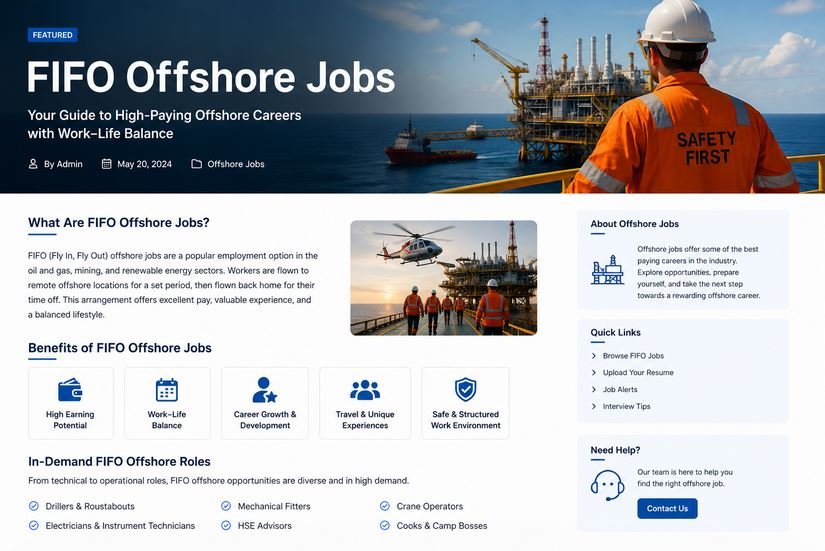
FIFO stands for Fly-In Fly-Out, a work arrangement where employees are transported to a remote worksite — typically an offshore oil platform, a floating production vessel, a wind farm installation ship, or a subsea construction site — and then flown back home at the end of their roster. Unlike traditional employment, you do not live near your workplace. You live wherever you want and commute by aircraft rather than by car or train.
The offshore component is the key differentiator from land-based FIFO Offshore Jobs mining. Offshore FIFO means your worksite is literally at sea — on a platform anchored above an oil reservoir, on a pipe-laying vessel, on a wind turbine installation jack-up barge, or on a floating hotel servicing multiple installations. The isolation, the hazardous environment, and the specialist nature of the work are precisely why offshore FIFO jobs command premium pay packages.
The most important thing to understand is that FIFO offshore employment is not a niche career path for a handful of specialists. Hundreds of thousands of workers globally hold offshore FIFO roles across dozens of disciplines — from mechanical and electrical maintenance to catering, medics, logistics coordinators, IT technicians, and environmental officers. If a skill is needed on land, it is almost certainly needed offshore, and it pays considerably more.
How Do FIFO Offshore Rosters Work?
Understanding the roster structure is essential before you commit to an offshore career because it fundamentally shapes your lifestyle. The most common rotation schedules in the offshore industry are:
- 28 days on / 28 days off — The gold standard in the oil and gas sector. You work 28 consecutive days on the platform, then you are completely free for 28 days. Many workers use their time off for extended travel, property investing, or freelance consulting.
- 14 days on / 14 days off — Popular in the UK North Sea and some Australian operations. A shorter, more frequent rotation that many workers with young families prefer.
- 21 days on / 21 days off — Common in Southeast Asian and Middle Eastern operations.
- 2 weeks on / 1 week off — Seen in some marine survey and construction roles where projects have tighter timelines.
During your days on, the employer provides all accommodation, meals, laundry, and transport. Your living costs drop to near zero while working, which means almost your entire paycheck can go directly to savings, investments, or paying off debt. This is one of the most powerful financial advantages of FIFO offshore life that is rarely discussed in mainstream career advice.
Top 20+ FIFO Offshore Jobs (2026) – Roles, Descriptions & Apply Now
| # | FIFO Offshore Job | Job Description | Apply Now |
|---|---|---|---|
| 1 | Offshore Engineer | Design, maintain, and optimize offshore platforms, drilling systems, and production facilities. | Apply Now |
| 2 | Driller | Operate drilling equipment and oversee safe drilling operations on offshore rigs. | Apply Now |
| 3 | Roustabout | Entry-level offshore worker assisting with maintenance, cleaning, and material handling. | Apply Now |
| 4 | Floorhand | Support drilling crews by handling equipment, pipes, and rig floor operations. | Apply Now |
| 5 | Derrickhand | Manage drilling fluids and monitor equipment on the derrick platform. | Apply Now |
| 6 | Electrician | Install, inspect, and repair offshore electrical systems and equipment. | Apply Now |
| 7 | Mechanical Technician | Perform maintenance and troubleshooting of offshore machinery and systems. | Apply Now |
| 8 | Diesel Mechanic | Repair and maintain generators, engines, and heavy offshore equipment. | Apply Now |
| 9 | Safety Officer (HSE) | Ensure compliance with offshore health, safety, and environmental standards. | Apply Now |
| 10 | Offshore Medic | Provide emergency medical care and health support for offshore workers. | Apply Now |
| 11 | Offshore Nurse | Deliver healthcare services and manage workplace wellness programs offshore. | Apply Now |
| 12 | Crane Operator | Operate offshore cranes for loading, unloading, and heavy lifting operations. | Apply Now |
| 13 | Offshore Welder | Perform welding, fabrication, and structural repair work on offshore facilities. | Apply Now |
| 14 | Pipefitter | Install and maintain piping systems used in offshore production facilities. | Apply Now |
| 15 | Instrumentation Technician | Calibrate and maintain control systems and monitoring equipment offshore. | Apply Now |
| 16 | Logistics Coordinator | Manage transportation, inventory, and supply chain operations for offshore projects. | Apply Now |
| 17 | Offshore Rigger | Handle lifting equipment, rigging systems, and heavy-load operations safely. | Apply Now |
| 18 | Offshore Wind Technician | Install and maintain offshore wind turbines and renewable energy systems. | Apply Now |
| 19 | Offshore Cook / Chef | Prepare meals and manage catering services for offshore crews. | Apply Now |
| 20 | Camp Boss / Steward | Oversee accommodation, catering, and day-to-day offshore camp operations. | Apply Now |
offshore fifo jobs Salaries: What Does the Pay Actually Look Like?
Compensation is where FIFO offshore jobs genuinely separate themselves from almost every other trade or technical career path. Salaries vary by region, sector, seniority, and certification level, but the ranges below reflect realistic 2025 market rates based on industry data from Australia, the UK North Sea, the Gulf of Mexico, and the Middle East:
- Offshore Roustabout / Entry-Level Roughneck: AUD $80,000–$110,000 (Australia) | USD $55,000–$75,000 (Gulf of Mexico)
- Offshore Electrician / Instrument Technician: AUD $130,000–$175,000 | GBP £55,000–£80,000 (UK North Sea)
- Offshore Drilling Engineer: USD $110,000–$180,000 globally
- Offshore OIM (Offshore Installation Manager): USD $200,000–$350,000+ depending on region and operator
- Offshore Medic / Paramedic: AUD $110,000–$150,000 | GBP £45,000–£65,000
- Offshore Catering Supervisor: AUD $90,000–$120,000
- Offshore IT / Communications Technician: USD $80,000–$130,000
- Subsea Engineer: USD $120,000–$200,000
Beyond base salary, most offshore FIFO packages include daily offshore allowances (sometimes called disturbance pay), flight coverage to and from your nearest airport, full accommodation and meals, private health insurance, life and disability insurance, and in many regions, tax advantages for working in international waters or remote area designations. When you total everything up, the effective compensation of an offshore worker typically exceeds their base salary by 20–40%.
Which Industries Hire FIFO Offshore Workers?
The offshore FIFO sector is far broader than most job seekers realize. While oil and gas historically dominated the conversation, a new wave of offshore industries is creating thousands of fresh positions annually:
1. Oil and Gas
The traditional engine of offshore FIFO employment. Platforms in the North Sea, Gulf of Mexico, Australia’s North West Shelf, and the Persian Gulf employ tens of thousands of workers in drilling, production, maintenance, logistics, and management roles. Despite energy transition pressures, global oil demand has kept investment in existing fields strong through 2025, particularly in the Middle East and Southeast Asia.
2. Offshore Wind Energy
This is the fastest-growing segment of the FIFO Offshore Jobs market right now. The UK, Germany, the Netherlands, the US East Coast, Taiwan, and Australia are all commissioning massive offshore wind farms that require installation crews, cable-laying technicians, turbine maintenance specialists, and vessel crews during construction — and then ongoing O&M (operations and maintenance) teams for the 25-year life of the asset. Wind technicians with offshore certification are among the most sought-after workers in the entire energy sector in 2025.
3. Marine Construction and Subsea
Pipeline laying, subsea infrastructure installation, cable burial, and offshore platform fabrication all require massive specialist vessels staffed with FIFO crews. Roles include marine engineers, dynamic positioning officers, ROV pilots, divers, structural welders, and project engineers.
4. Mining and Resources (Offshore and Remote)
While technically not always offshore, remote mining operations in Western Australia, the Northern Territory, Papua New Guinea, and parts of Africa use an identical offshore fifo jobs model. Seabed mining — the extraction of polymetallic nodules from the ocean floor — is also emerging as a new frontier that will require dedicated offshore FIFO workforces.
5. Support Services
Every offshore installation needs catering crews, medics, logistics personnel, crane operators, radio operators, helicopter deck officers, and administrative staff. These roles are often the most accessible entry points for people who do not come from a traditional trades background but want to break into the offshore industry.
Essential Certifications to Get Your Offshore FIFO Career Started
One of the biggest misconceptions about offshore FIFO jobs is that they require university degrees. In reality, your certifications matter far more than your academic credentials. The following are the most important offshore safety and competency certificates that employers look for:
- BOSIET (Basic Offshore Safety Induction and Emergency Training) — The mandatory entry-level certificate for anyone working offshore in the oil and gas sector. Covers helicopter underwater escape, firefighting, sea survival, and first aid. Valid for 4 years.
- HUET (Helicopter Underwater Escape Training) — Often included within BOSIET but sometimes required as a standalone refresher. Tests your ability to escape from a submerged helicopter simulator.
- OPITO Standards — The global benchmark framework for offshore competency, widely recognized in the North Sea, Middle East, and Southeast Asia.
- GWO (Global Wind Organisation) Basic Safety Training — The equivalent of BOSIET for the offshore wind sector. Covers working at heights, first aid, fire awareness, manual handling, and sea survival.
- STCW (Standards of Training, Certification and Watchkeeping) — Essential for anyone working on marine vessels rather than fixed platforms.
- IWCF / IADC Well Control Certificates — Required for drilling-specific roles such as driller, tool pusher, and drilling engineer.
- Offshore Medical Certificate (Fitness to Work Offshore) — Issued by an approved medical examiner; all offshore workers must hold a current one before going offshore.
Most of these certifications can be completed within days to weeks, not years. Many employers in the offshore sector will subsidize or fully cover the cost of mandatory safety training for workers they are about to hire, so do not let certification costs be a barrier to applying.
Top Countries and Regions Hiring offshore FIFO jobs Workers Right Now
Geography matters enormously in the offshore FIFO job market. Each region has its own visa requirements, certification recognition standards, salary scales, and dominant industries. Here is where the opportunities are most concentrated in 2025:
Australia
Australia remains one of the world’s premier destinations for FIFO Offshore Jobs, particularly in Western Australia’s oil and gas sector (Woodside, Chevron, Santos, Inpex) and the rapidly growing offshore wind developments off the Victorian and NSW coasts. Australian offshore workers benefit from strong union protections, world-class safety standards, and some of the highest offshore wages globally. Citizenship or permanent residency is required for most roles, though some specialist contractor positions accept skilled worker visas.
United Kingdom (North Sea)
The UK North Sea has been the backbone of European offshore employment for over 50 years. Aberdeen is the primary hub. While the mature conventional oil sector has shed jobs through efficiency gains, the North Sea offshore wind boom — with projects like Dogger Bank and Hornsea — is absorbing and creating thousands of new FIFO positions. The UK’s visa sponsorship routes (Skilled Worker Visa) make it accessible to international applicants in shortage occupations.
Middle East (UAE, Saudi Arabia, Qatar)
The Gulf region continues to invest heavily in offshore oil and gas development. Salaries are competitive and many packages are tax-free for expatriate workers, significantly boosting take-home pay. ADNOC (Abu Dhabi), Saudi Aramco, and Qatar Energy are among the world’s largest operators and regularly hire international FIFO workers on contract rotations.
Southeast Asia (Malaysia, Indonesia, Vietnam)
PETRONAS, Medco, and a host of international operators maintain active offshore programs across the South China Sea and the Malacca Strait region. These markets can be slightly lower-paying than Australia or the UK but offer excellent entry points for workers building their offshore experience record — which is then transferable to higher-paying markets.
Gulf of Mexico (United States)
The deepwater Gulf of Mexico is one of the most technically demanding — and best-compensated — offshore environments in the world. Operators like Shell, BP, Chevron, and ExxonMobil run deepwater facilities that pay premium wages for experienced personnel. Most roles require US citizenship or a valid work authorization, and union membership is common for trades positions.
The Real Lifestyle: Pros and Challenges of FIFO Offshore Jobs work
No honest guide to FIFO offshore careers can skip this section. The lifestyle has genuine, life-changing advantages — but it also comes with real challenges that every candidate should evaluate honestly before committing.
The Genuine Advantages
- Financial acceleration: With minimal living expenses on-swing and premium salaries, many FIFO workers pay off mortgages, build investment portfolios, or reach financial independence 10–15 years faster than their onshore peers.
- Extended time off: Nearly half the year completely free is genuinely life-changing for family time, travel, hobbies, and side projects.
- Career progression: Offshore environments are meritocratic. Performance matters more than politics, and promotions can come quickly for skilled, reliable workers.
- World-class experience: Working on cutting-edge offshore infrastructure — deepwater drilling rigs, LNG FPSOs, offshore wind turbines — builds a CV that opens doors globally.
- Camaraderie: The close-knit nature of offshore crews creates strong professional networks and lifelong friendships.
The Honest Challenges
- Family separation: Missing birthdays, school events, anniversaries, and everyday family life is the most cited reason workers leave the offshore sector. Strong communication strategies and partner buy-in are essential.
- Mental health pressures: Isolation, fatigue, and the transition between offshore intensity and home-life relaxation can create psychological strain. Reputable operators have improved mental health support significantly in recent years, but it remains a real consideration.
- Physical demands: Most offshore roles require physical fitness and the ability to work in all weather conditions. Medical fitness standards are strict and non-negotiable.
- Market volatility: Oil price crashes, project cancellations, and energy transition uncertainty can result in contract terminations with minimal notice.
- Limited connectivity: While satellite internet has improved dramatically, full connectivity is still not available on all vessels and platforms.
Step-by-Step: How to Get Your First FIFO Offshore Job
Breaking into the offshore FIFO sector can feel daunting, particularly because most advertised positions ask for prior offshore experience. Here is the practical pathway that experienced offshore workers recommend:
- Step 1 — Get your offshore medical certificate first. Without it, you cannot go offshore, and employers will not consider you seriously. Book with an OGUK-approved (UK) or equivalent practitioner in your country.
- Step 2 — Complete your BOSIET or GWO Basic Safety Training depending on whether you are targeting oil & gas or offshore wind. These are your entry tickets to the industry.
- Step 3 — Identify your transferable trade or skill. What do you do onshore that is needed offshore? Electrical? Welding? Mechanical? Catering? Medical? Logistics? Every skill has an offshore equivalent that pays more.
- Step 4 — Target offshore service companies, not just operators. Companies like Petrofac, Worley, Wood, TechnipFMC, Subsea 7, Bilfinger, and DOF Subsea hire frequently and provide the entry-level pathway that operator-direct roles typically do not.
- Step 5 — Apply for shore-based roles in offshore companies. Working onshore for an offshore operator — in their logistics base, fabrication yard, or supply chain — is a highly effective way to build contacts and internal referrals that open offshore doors.
- Step 6 — Build your LinkedIn presence specifically for offshore. Keyword-optimise your profile for terms like ‘offshore technician,’ your specific certification names, and the geographic regions you are targeting.
- Step 7 — Register with specialist offshore recruitment agencies. Agencies like Fircroft, Spencer Ogden, Petroplan, Air Energi, and NES Fircroft focus exclusively on energy and offshore placement and have relationships with operators and contractors that general job boards do not.
FIFO offshore jobs represent one of the most legitimate pathways to financial freedom, global experience, and a genuinely flexible lifestyle available to working professionals in 2025. The combination of premium pay, time off that rivals any other industry, and career trajectories that reward merit over credentials makes it a compelling choice — provided you go in with eyes open about the genuine challenges. The workers who thrive offshore tend to be organized, adaptable, physically fit, and emotionally resilient. If that sounds like you, the offshore FIFO world is waiting — and it is far more accessible than most people assume.
FAQs
Do I need a university degree to get an offshore FIFO job?
No — and this is one of the most important things to understand about the offshore sector. The vast majority of offshore FIFO roles are based on trade qualifications, safety certifications, and demonstrated competency rather than academic degrees. A qualified electrician, welder, plumber, or mechanical fitter with the right offshore safety certificates will be hired ahead of a university graduate with no practical skills. Engineering and managerial roles may require degrees, but the workforce that actually runs offshore installations is predominantly trade-qualified.
How do FIFO Offshore Jobs workers manage their mental health and family relationships?
This is the most personal challenge in the offshore lifestyle, and successful FIFO workers approach it deliberately rather than hoping it will work out on its own. Regular video calls during your time offshore, creating strong routines and rituals for your days off (family activities, date nights, individual traditions), seeking peer support from colleagues who understand the lifestyle, and using the mental health resources that most reputable offshore employers now provide are all proven strategies. Partners also benefit from connecting with other FIFO families, both for practical support and to normalize the lifestyle.
Is offshore FIFO work safe in 2025?
Safety has been the offshore industry’s primary focus for decades, particularly following major incidents like Piper Alpha and the Deepwater Horizon disaster. The statistical reality is that the modern offshore industry has safety records that are significantly better than construction, agriculture, and many other industries commonly considered ‘normal.’ Major operators invest enormous resources in safety management systems, mandatory training, and a culture of stop-work authority — meaning any worker can halt an operation if they believe it is unsafe without fear of repercussion. That said, offshore work is inherently more hazardous than office work, and the physical and environmental risks are real.
Can I work in FIFO Offshore Jobs internationally if I am from India, the Philippines, or another non-Western country?
Absolutely — and thousands do. The global offshore industry is genuinely international, particularly for skilled trades. Filipino marine and catering professionals, Indian drilling engineers, and Indonesian logistics personnel are all well-represented across global offshore operations. The Middle East, Southeast Asia, and some African operations are particularly open to international workforces. The key requirements are internationally recognized certifications (OPITO, STCW, BOSIET), proven competency, English language proficiency in most regions, and the relevant work authorization or visa for the country of operation.
How long does it typically take to get from applying to actually working offshore for the first time?
For someone starting with no offshore experience but a strong trade background, the realistic timeline from decision to first offshore swing is typically three to six months. This accounts for time to complete your offshore medical (one to two weeks to book and complete), BOSIET or GWO training (four to five days each), job searching and interview processes (one to three months depending on market conditions), pre-employment screening, and mobilization logistics. Workers who already have their certifications and are moving from one offshore employer to another can be deployed within weeks.
