
Singapore stands as a beacon of opportunity for Indian professionals seeking to advance their careers in a global financial hub. With a thriving economy, competitive salaries, and a multicultural workforce, the island nation has become increasingly attractive to Indian talent across industries like finance, technology, healthcare, and engineering.
If you’re an Indian professional wondering whether Singapore is the right next step in your career, you’re not alone. Thousands of Indians have successfully transitioned to Singapore, securing well-paying jobs while enjoying a high standard of living. However, navigating the job market, understanding visa requirements, and identifying which sectors offer the best opportunities requires strategic planning and current market knowledge.
Here we walk you through Singapore vacancy for Indian and everything you need to know about finding and securing employment in Singapore, from identifying in-demand roles to understanding the work visa process and cultural adaptation.
Key Takeaways
- Singapore offers competitive salaries 20-40% higher than India, with strong demand for IT professionals, financial analysts, healthcare workers, and engineers across multinational corporations and local enterprises.
- Employment Pass (EP) and S Pass remain the primary visa routes for Indian professionals, requiring sponsorship from employers and meeting specific salary and qualification thresholds.
- Top hiring sectors include fintech, banking, IT infrastructure, manufacturing, and healthcare, with Singapore’s commitment to digital transformation and regional expansion driving continuous demand.
- Indian professionals benefit from Singapore’s multicultural environment, established Indian communities, and professional networks that ease transition and career advancement.
- Strategic job searching involves leveraging LinkedIn, specialized job portals like Indeed and JobStreet, networking with recruiters, and timing applications with financial year cycles to maximize interview opportunities.
Why Singapore? Understanding the Market Appeal for Indian Professionals
Singapore vacancy for Indian as Asia’s leading financial center and technology hub has made it a preferred destination for Indian talent. Unlike other developed nations, Singapore offers several distinct advantages that resonate with Indian professionals seeking career growth without sacrificing cultural familiarity.
The city-state hosts over 7,000 multinational companies, many of which have regional headquarters in Singapore. These organizations actively recruit from India because Indian professionals bring strong technical expertise, cost-effectiveness relative to local talent, and cultural alignment in a multicultural workplace. The Indian diaspora in Singapore exceeds 300,000 people, creating established communities, religious institutions, and professional networks that facilitate smooth transition.
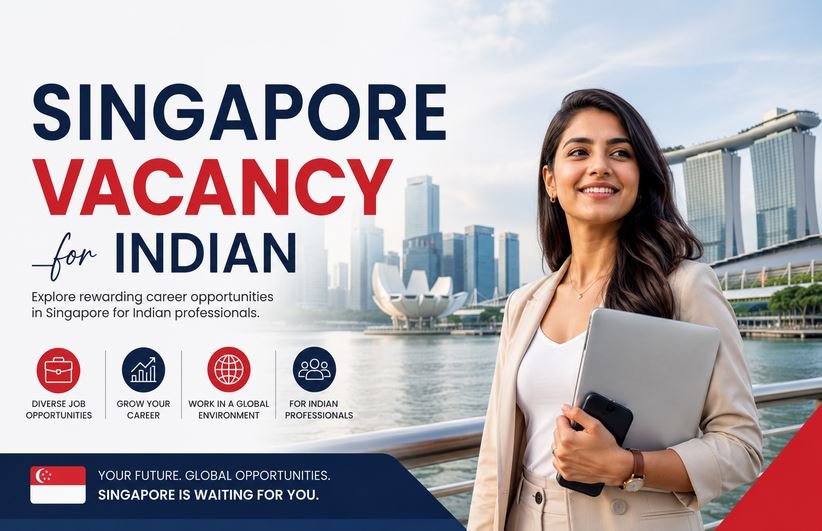
Salary packages in Singapore are significantly higher than India. An IT professional earning ₹12-15 lakhs annually in India could expect SGD 4,500-6,500 (approximately ₹27-39 lakhs) in Singapore, even accounting for higher living costs. The purchasing power advantage remains substantial.
Singapore’s business environment prioritizes innovation and growth. The government actively promotes sectors like fintech, artificial intelligence, and sustainable technology—fields where Indian talent excels. This strategic focus translates into job creation and career advancement opportunities.
In-Demand Singapore vacancy for Indian: Where Indian Professionals Excel
Understanding which sectors actively hire Indian professionals helps you target your job search effectively and improve your placement chances.
Finance and Fintech
Singapore’s financial sector is booming, with fintech startups and established banks constantly seeking analytical minds. Roles include financial analysts, risk managers, data scientists, and compliance officers. Indian professionals, renowned for quantitative skills, find abundant opportunities here.
Financial institutions value the combination of strong analytical capabilities and cultural diversity that Singapore vacancy for Indian professionals bring. With fintech disrupting traditional banking, demand for professionals who understand both traditional finance and emerging technologies remains consistently high.
Information Technology and Software Development
The tech sector represents the largest employment category for Indian professionals in Singapore. Cloud engineers, full-stack developers, solutions architects, and cybersecurity specialists are perpetually in demand.
Singapore’s push toward becoming a smart nation requires continuous investment in IT infrastructure. Multinational tech companies like Microsoft, Google, and Amazon maintain significant engineering teams in Singapore, actively recruiting Indian talent from companies like TCS, Infosys, and through direct hire.
Healthcare and Medical Services
Nursing, allied healthcare, and medical specialist positions face chronic shortages. Indian healthcare professionals, trained to international standards, are highly valued. Hospitals and healthcare facilities offer sponsorship and competitive packages to attract quality candidates.
Manufacturing and Engineering
Singapore’s advanced manufacturing sector, including semiconductor and precision engineering, seeks skilled engineers. Indian professionals with experience in these domains find strong demand, particularly those with certifications in specialized areas.
Business Services and Consulting
Management consulting, business analysis, and operations roles in companies like Accenture, Deloitte, and EY actively recruit Indian professionals. Communication skills combined with technical knowledge make Indians competitive candidates.
Work Visa Requirements: The Path to Employment
Understanding Singapore’s visa framework is crucial before beginning your job search. The primary work visa categories for Indian professionals are:
Employment Pass (EP)
The Employment Pass is the most common visa for skilled professionals. Eligibility requires:
- Monthly fixed salary of at least SGD 3,600-4,500 (depending on qualifications)
- Bachelor’s degree or equivalent qualification
- Job offer from a Singapore-registered company
- The employer must demonstrate they couldn’t find suitable local talent
The EP allows you to work for the sponsoring employer, though you can change employers with a new sponsorship. Processing typically takes 2-4 weeks.
S Pass
The S Pass targets semi-skilled workers with:
- Monthly salary of SGD 2,500-3,600
- Relevant vocational training or skills certification
- Employer sponsorship and justification for hiring foreign talent
Tech.Pass
Introduced for technology professionals, the Tech. Pass offers faster processing and higher salary thresholds, with the possibility of self-sponsorship if your salary exceeds SGD 8,000 monthly. This visa suits experienced tech professionals.
Dependent Pass and Long-Term Visit Pass
Once employed, you can sponsor family members through dependent passes. Spouses and children below 21 can be included, though this involves additional documentation and sponsorship responsibilities.
Top Platforms and Strategies for Job Hunting in Singapore
Successful job search in Singapore requires strategic use of platforms and understanding of local hiring practices.
Specialized Job Portals
JobStreet (Singapore’s largest job portal) lists thousands of positions across all sectors. Filter by company, salary, and experience level. Most employers post vacancies here first.
LinkedIn is essential. Optimize your profile with current contact information, highlight key achievements, and actively connect with Singapore-based recruiters and professionals in your industry.
Indeed Singapore aggregates postings from company websites and other sources, providing broad coverage of available positions.
Recruitment Agencies
Registered agencies like Kelly Services, Robert Half, and specialized tech recruiters often have faster pathways to interviews. They understand visa requirements and company preferences, and many operate without charging candidates.
Direct Company Applications
Multinational companies with Singapore vacancy for Indian and other operations often post positions on their corporate websites. Applying directly can yield faster responses and demonstrate genuine interest.
Networking and Professional Groups
Join professional associations, LinkedIn groups, and Singapore-based Indian professional networks. Many positions are filled through referrals before public posting. Attending industry conferences and meetups increases visibility.
Salary Expectations and Negotiation
Salary varies by sector, experience, and company. A mid-level IT professional might expect SGD 5,000-7,000 monthly; a senior manager SGD 8,000-12,000+; and specialized healthcare professionals SGD 4,500-7,500.
When negotiating, research market rates using Glassdoor, PayScale, and LinkedIn Salary insights. Factor in mandatory Central Provident Fund (CPF) contributions (around 17% of salary split between employer and employee). Confirm whether the offered salary is fixed or includes variable components.
Ask about relocation benefits, moving allowances, and airfare. Many companies provide these, especially for senior positions.
Preparing Your Application: Resume and Interview Tips
Resume Optimization: Tailor your resume for Singapore employers. Highlight international experience, English proficiency, and sector-specific certifications. Use a modern format; conservative is preferred.
Cover Letters: Personalize each cover letter. Mention familiarity with Singapore’s business environment and explain your genuine interest in the role and company.
Interview Preparation: Singapore interviews are typically professional and formal. Research the company thoroughly, prepare for behavioral questions, and practice articulating your achievements quantitatively.
Background Checks: Expect thorough background verification. Ensure your credentials are accurate and your employment history is verifiable.
Cost of Living and Quality of Life Considerations
While Singapore vacancy for Indian is higher and salary also than India, so is the cost of living. Expect monthly expenses of SGD 2,000-3,500 for a single person in reasonable comfort. Housing is the largest expense; sharing apartments with colleagues is common initially.
However, Singapore offers superior public infrastructure, healthcare, education, and safety compared to most Indian cities. Many Indians find that even after expenses, their savings rate exceeds what they could achieve in India at higher absolute salaries.
Cultural Adaptation and Community Support
Singapore’s multicultural environment makes integration easier for Indians. Temples, Indian restaurants, and community centers are widespread. Learning Mandarin basics helps socially, though English is the business language.
Professional networks like Singapore Indian Chamber of Commerce & Industry and numerous LinkedIn groups facilitate peer connections and knowledge sharing. Most Indians report successful adaptation within 3-6 months.
Timeline and Action Plan
Months 1-2: Update resume, optimize LinkedIn profile, identify target companies and roles.
Months 3-4: Begin applications, attend virtual job fairs, connect with recruiters actively.
Months 5-6: Interview scheduling, prepare documentation for visa sponsorship, finalize offers.
Months 7-8: Complete visa processing, arrange relocation logistics.
This timeline is flexible but demonstrates that Singapore placement typically requires 4-6 months of active effort.
FAQs
Do I need to speak Mandarin to work in Singapore?
No. English is the primary business language and is widely spoken. While learning basic Mandarin enhances social integration and shows respect for local culture, it’s not mandatory for employment. Most Indian professionals manage successfully with English alone, though learning conversational Mandarin within the first year improves overall experience.
What is the difference between Employment Pass and S Pass? Which should I target?
The Employment Pass (EP) is for graduates and skilled professionals, requiring higher salary thresholds (SGD 3,600+) but offering broader career flexibility and better long-term prospects. The S Pass targets semi-skilled workers with vocational qualifications and lower salary requirements (SGD 2,500-3,600). Target the EP if you have a degree; choose S Pass if you have vocational training but no formal degree. Most Indian professionals qualify for EP.
Can my family accompany me on a work visa?
Yes. Once you secure Singapore vacancy for Indian and obtain an EP, you can sponsor your spouse and children under 21 through dependent passes. The employer must support this, and you’ll need to demonstrate financial capability. However, dependents cannot work unless they secure independent employment visas.
How long does the visa application process take?
Standard Employment Pass processing takes 2-4 weeks from the time your employer submits the application. Tech.Pass can be processed within days. Delays occur if documentation is incomplete or background verification requires additional checks. Plan for 4-6 weeks to account for unexpected delays.
Is it worth moving to Singapore from India? What are the real financial benefits?
For most Indian professionals, the answer is yes. You’ll earn 3-4x your India salary, face significantly lower taxation (progressive tax rates peak at 22%), and access superior quality of life. However, you’ll spend more on accommodation, food, and transportation. Realistically, a mid-level professional can save SGD 1,500-2,500 monthly, equivalent to ₹9-15 lakhs annually—substantially more than comparable India savings. The investment in career growth, international experience, and network building adds immeasurable value beyond financial metrics.
Final Thoughts
Singapore represents a genuine Singapore vacancy for Indian professionals willing to invest effort in strategic job hunting and relocation. The combination of competitive salaries, career growth, multicultural acceptance, and quality of life makes it an attractive destination. Success requires realistic expectations, thorough research, persistent networking, and professional preparation. Start today by optimizing your LinkedIn profile and researching target companies. The next position could be the career milestone you’ve been seeking—and it might be waiting for you in Singapore.
